




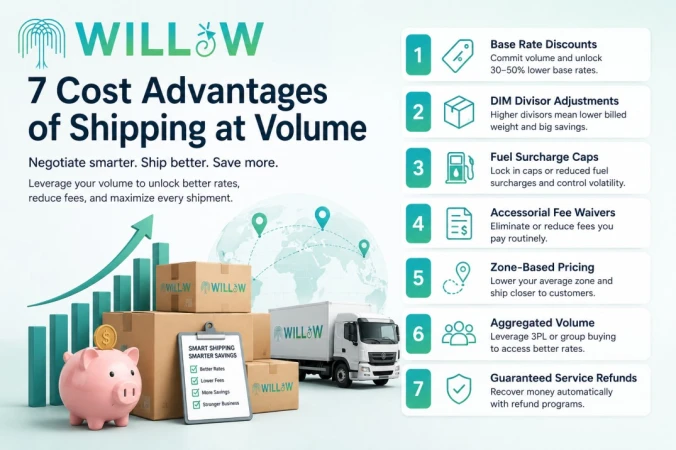
7 Carrier Cost Advantages That Come With Shipping at Volume
 Ankit Gupta
- Jun 04, 2026
- 85
- 0
The mobile app world is changing a lot now. It was worth $365 billion in 2024. Is expected to grow to $673 billion by 2030. This means it will grow by 10.8% every year.. Whats happening behind this growth is that people are changing how they use apps.
There's something called "app fatigue" thats becoming a problem. People are getting tired of managing different apps. Data for 2025 and 2026 shows that people are starting to use apps and instead prefer a few apps that can do many things. These are called " apps". They combine things like shopping, paying bills, playing games and watching media into one app.
Big companies are fighting to get their apps into the four apps that people use every day. For developers and studios it's hard to compete in areas like social media, fitness tracking or productivity. It's just too expensive to get customers.
Even though big companies are taking over the 2026 landscape has a lot of opportunities for players to make a lot of money. The independent developer has an advantage: they can specialize in a small area and still make a good living. Big technology companies have a lot of expenses so they ignore markets that only make $500,000 to $5 million per year.. For an independent developer getting a small part of a $1 million market can be very profitable. Specializing in something beats trying to do everything in a market.
Also the way we develop apps has changed a lot. This has changed the costs of making an app. Now we have tools like Flutter and React Native that let us make apps for platforms at once and we have cloud architectures that are easy to use and do not require a lot of coding. We also have intelligence that helps us with programming. All these things have made it easier for people to start making apps. Because coding is cheaper now the important thing for an independent developer is to be an expert in a specific area and solve problems that are unique to that area.
The best Total Addressable Market is 100 million users or worldwide. If you have than 10 million users you will only make $1 million to $5 million per year.
The cost of getting a customer should be between $0.50 and $3.00 especially if you are targeting a small group of people. The average cost is $2.47. If it costs much to get new customers it can hurt your business.
The value of a customer over their lifetime should be three to five times the cost of getting that customer so you can keep putting money into marketing.
After 30 days you should still have least 20% of your customers using your app. If you can keep 10% customers you can increase your revenue by 30-40%. Independent developers, like the developer can use these metrics to make a lot of money. The independent developer has to focus on the Total Addressable Market and the cost of getting new customers to be successful.
A critical third-order trend emerging across productivity, creator economy, and B2B SaaS sectors is the widespread consumer rejection of "bolted-on" Artificial Intelligence. Across digital forums, there is acute frustration with the ubiquitous integration of generic generative AI. Integrating chatbots into existing workflows has paradoxical effects; rather than reducing friction, it increases the user's cognitive load. Users complain heavily about feature bloat and the mental overhead required to verify AI-generated actions.
The applications positioned to capture massive market share in 2026 are those deploying "invisible AI." This involves utilizing machine learning silently in the background—processing localized edge-computing data, automating tagging mechanisms, or rendering diagnostics—without demanding continuous prompting. Below are five meticulously engineered application blueprints designed for robust unit economics and global scalability.
The Market Problem: The remote work revolution has precipitated a global epidemic of postural dysfunction. Desk-bound professionals suffer chronic neck pain, yet ignore generic notifications. Existing hardware solutions like the Upright Go ($60-$100) are uncomfortable and rely on simplistic vibration. Software like SitSense demands continuous webcam monitoring, draining batteries and causing severe privacy anxiety.
The Specialized Solution: AlignSight AI eliminates hardware and cloud processing entirely. By utilizing native OS machine learning (Apple's CoreML or Android's ML Kit), the app maps joint angles from a single static side-profile photograph to identify deviations. The unique selling proposition is absolute privacy—zero photographic data leaves the device.
The problem is that the global creator economy is an industry it is worth $191.5 billion. Because of some changes to algorithms people are now looking for videos, not ones made by computers. This means that people who make videos for YouTube are having a time dealing with all the extra footage they have. They have much footage that it is hard to find what they need. The big companies that make software to help with this like Bynder and Adobe are made for teams and need a lot of space on the internet to work. This is a problem for people who make videos because they need to be able to find their footage
The solution is ClipVault Local. It is a program that you can use on your computer without needing to be connected to the internet. It uses computer models to look at your video footage and add labels to it like "drone" and "sunset". It does all of this on your computer so you do not need to upload anything to the internet. This makes it very fast. You do not have to pay any extra fees to use it.
To make money from this we can sell it to businesses for a one-time fee of $79 to $129. If we can sell it to 150 people per month we will make $14,850. We will not have to pay a lot of money to keep it running.
First we need to make a version of the program that can quickly look at all the footage on your computer show you small pictures of the videos and let you search for what you need. We do not need to make it work with the internet or let multiple people use it at first.
This can be very successful in places, like the US, UK and Germany where people make a lot of videos. We can sell it to them directly. Also get people who review technology to tell others about it.
The problem that needs to be solved is that a lot of mobile food vendors are having trouble with fire codes and health permits. This is because big companies that make compliance software, like ZenGRC and TrustArc charge a lot of money. Between $2,500 per month to $22,000 per year. So food trucks use checklists and calendar reminders which can be easily lost. This leads to missed renewals and fines from the city.
PermitPark is a solution to this problem. It is a very affordable and easy to use compliance dashboard that works well on devices. Food vendors can upload pictures of their permits and PermitPark will send them reminders by text and email when it is time to renew. They can also use PermitPark to check their food safety every day before they start serving.
To make money PermitPark will charge a fee of $14.99 to $24.99 to food trucks. If 600 food trucks sign up that is $9,000 to $15,000 per month which's a lot of money. This is especially true because it can help food trucks avoid getting fined $500.
To start PermitPark needs to build a way for vendors to upload their permits safely a dashboard that shows when permits are due and a way to send reminders by text and email. PermitPark should not try to connect to city databases or complicated payment systems.
PermitPark can grow by advertising on Facebook to food truck owners in areas and by using search engine optimization to show up in search results when people look for things, like "food truck permits".
The problem that needs to be solved is that field service engineers often work in tough places like ship hulls and mining shafts where they do not have access to the internet. The current systems that are available such as ServiceTitan and Jobber are very expensive costing between 60 and 350 dollars per user per month. These systems are mostly used for sending out workers and making invoices. They are not very good at handling files with lots of pages and high quality pictures when the internet is not available. This can cause the system to crash. It is also hard for technicians to use these systems when they are wearing gloves.
The solution that RuggedDoc offers is to make sure that these big technical manuals are available on tablets even when there is no internet. RuggedDoc uses the voice to text feature that is built into the tablets operating system. This means that technicians can give commands without having to touch the screen. For example they can say "zoom in on circuit diagram B".
The way that RuggedDoc will make money is by charging a fee of 39 dollars per user. If RuggedDoc can get 300 engineers to use the system it will make 11,700 dollars per month. This is a way to make money because engineers will keep using the system for a long time and it is unlikely that they will stop.
To start RuggedDoc will focus on making sure that the system can store files on the tablet and show them clearly without using too much memory. It will also have voice commands that work when there is no internet. RuggedDoc will not try to do everything at once it will just focus on the important things.
RuggedDoc can be used by lots of people because the documents that it uses are standardized around the world. To grow RuggedDoc will use a sales approach that is tailored to each company using LinkedIn to find new customers. RuggedDoc will be a solution for Heavy Industry because it is designed to work in tough environments where other systems fail. RuggedDoc is, about making it easy for field service engineers to use technical manuals when they are working offline.
The Market Problem: The pet relocation market is expanding from $2.4 billion to $5.3 billion by 2034. However, corporate shipping agencies extract monopolistic handling fees (up to $2,497). Conversely, gig-economy platforms (like PetBacker) levy predatory commissions of up to 25% on drivers, causing resentment and driving top suppliers to disorganized, scam-ridden Facebook groups.
The Specialized Solution: PawsRoute Direct inverts the paradigm through a "SaaS-for-supply" marketplace. Pet owners utilize the search platform entirely for free. Independent drivers and flight nannies pay a flat monthly subscription to list availability, allowing them to keep 100% of their negotiated earnings and directly communicate with clients.
The big change for software developers is clear: they should stop using platforms that try to do everything and start focusing on the business to business way of doing things. People are willing to pay a lot of money for software that solves problems they have at work and they are less likely to stop using it which helps software developers make a lot of money like ten thousand dollars per month.
If software developers say no to models that just take and take are very careful about what features they add when they are first starting out and use intelligence in a way that users do not even notice they can build software that grows and makes money quickly and easily in 2026. Software development and 2026 implementation will be very important, for software developers.
Micro-SaaS
B2B SaaS
Mobile App Ideas 2026
High CPC App Niches
Cross-Platform Development
React Native
AI App Ideas
Software Business Models
Independent Developer Strategy
App Development Trends
Startup Ideas
Invisible AI
Subscription Business Model